CV for Construction Trades in the UK 2026 — CSCS Guide
The UK housing shortage means construction cannot hire fast enough. The Construction Industry Training Board (CITB) forecasts 225,000 additional workers needed by 2027. Electricians, plumbers, and general trades earn £35,000–£55,000 depending on specialism and region (ONS ASHE 2025). Employers like Balfour Beatty, Kier Group, and Taylor Wimpey recruit through Workday and Oracle Taleo — meaning your CV must pass ATS filters before a site manager sees it. CSCS cards, NVQ qualifications, and trade-specific certifications are non-negotiable on a construction CV. Here is exactly how to format yours.
What do construction trades earn in the UK in 2026?
Skilled construction trades in the UK earn between £35,000 and £55,000 per year in 2026. Self-employed tradespeople on day rates often earn more. Data from ONS Annual Survey of Hours and Earnings (ASHE) 2025 and industry estimates:
- Electrician (employed): £38,000–£48,000/year
- Electrician (self-employed day rate): £200–£300/day
- Plumber/Gas engineer: £35,000–£50,000/year
- Carpenter/Joiner: £32,000–£42,000/year
- Bricklayer: £35,000–£48,000/year (shortage premium in 2026)
- Site supervisor/foreman: £45,000–£55,000/year
- London and South East: +15-25% above national averages
Key employers: Balfour Beatty (UK's largest contractor), Kier Group, Taylor Wimpey (housebuilding), Persimmon, Wates Group, and specialist subcontractors across mechanical and electrical.
What CV format do construction employers expect?
Large construction firms (Balfour Beatty, Kier, Taylor Wimpey) use Workday or Oracle Taleo as their ATS. Subcontractors and agencies (Hays Construction, Randstad) use SmartRecruiters or internal systems. All want a clean, no-frills CV:
- Length: 1–2 pages. One page is fine for operatives. Two for supervisors/project managers.
- CSCS card placement: State your CSCS card type and expiry date in the header area or certifications section. It is the first thing site managers look for.
- Sections: Contact → CSCS/Trade cards → Personal statement → Key qualifications → Work experience → Training/Certifications → References
- Right to Work: State clearly. Construction is a Skilled Worker visa-eligible sector for many trades.
- No photo, no DOB — standard UK convention.
- File format: PDF. Keep formatting minimal — site managers often view on mobile.
How to describe construction experience on a UK CV
Construction recruiters want to see project scale, your specific trade role, and safety compliance. Vague descriptions waste everyone's time.
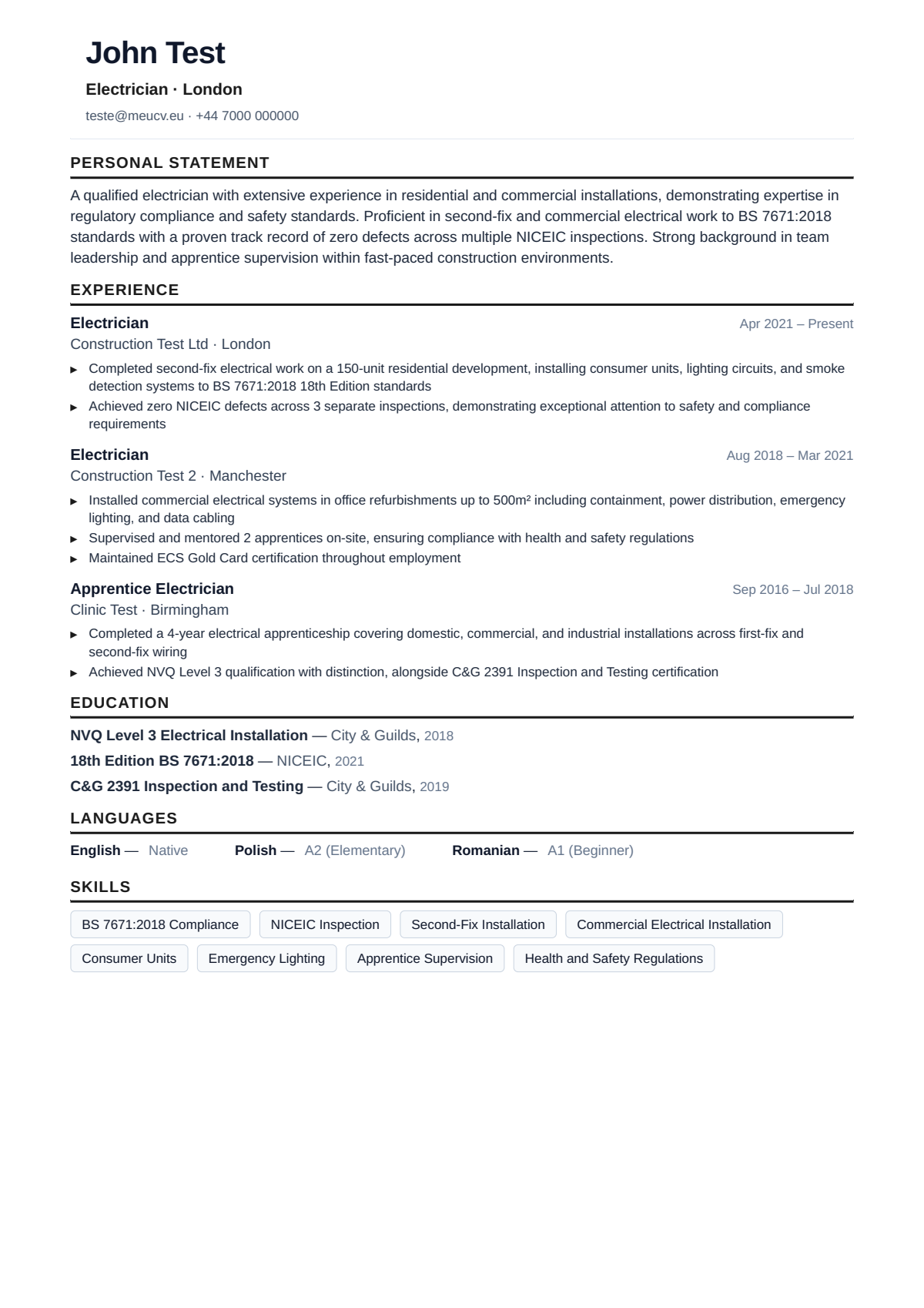
Before (weak): "Worked as an electrician on building sites." After (strong): "Second-fix electrician on 120-unit residential development (Taylor Wimpey, Reading). Installed consumer units, lighting circuits, and fire alarm systems to BS 7671:2018. Completed 15 units/month with zero NICEIC defects across 3 inspections."
Before (weak): "Did plumbing work for houses." After (strong): "Lead plumber on new-build housing estate (Persimmon, Bristol). First and second fix — unvented hot water, underfloor heating, and soil/waste systems for 80 plots. Achieved Gas Safe compliance on all installations."
Include: project type (residential, commercial, infrastructure), scale (number of units, contract value), compliance standards met, and any supervisory responsibility.
Which certifications must appear on a construction CV?
Construction is heavily regulated. Missing certifications means no site access — and no interview. These are essential:
- CSCS card — mandatory for all UK construction sites. State card type (colour), number, and expiry date.
- NVQ/SVQ Level 2 or 3 — in your specific trade. Required for CSCS Blue/Gold cards. Electricians: NVQ Level 3 in Electrotechnical Services.
- ECS card (Electrotechnical Certification Scheme) — for electricians. Gold card = qualified, verified by JIB.
- Gas Safe registration — mandatory for any gas work. State your registration number.
- SSSTS or SMSTS — Site Supervisor/Site Manager Safety Training Scheme. Essential for supervisory roles.
- First Aid at Work — 3-day certificate. Required on most sites for at least one person per team.
- Asbestos Awareness (UKATA) — legally required for anyone who may disturb asbestos. Half-day course.
5 errors that get your construction CV rejected in the UK
- Missing CSCS card details — without card type and expiry, your CV goes straight to the bottom. No card = no site access.
- No project scale or compliance — 'worked on building sites' tells nothing. State project size, value, and standards met (BS 7671, Gas Safe, etc.).
- Using non-UK trade terminology — 'eletricista', 'fontanero' get zero ATS matches. Use UK titles: Electrician, Plumber, Carpenter, Bricklayer.
- Including a photo or personal details — UK construction recruiters do not want to see your face, age, or nationality before interview.
- Overly designed CV — construction hiring managers read CVs on their phones between site visits. Keep it simple, single-column, text-only.
Your next step: build your trades CV today
The UK needs 225,000 more construction workers by 2027. If you hold trade qualifications and a CSCS card (or equivalent), the demand is there. A properly formatted CV gets you from application to site in weeks, not months.
MeuCV builds construction CVs that Workday and Oracle Taleo can parse — CSCS card prominent, NVQ qualifications highlighted, project-scale achievements formatted for ATS scoring. From £4.99. Takes 5 minutes.
Related reads
Healthcare, logistics, retail, hospitality — discover the 7 UK jobs with the most vacancies in 2026, salary ranges, and what employers actually look for.
CV for HGV Driver in the UK 2026 — Logistics GuideHGV and delivery drivers earn £35-50K in post-Brexit UK logistics. Write a driver CV with CPC, tacho, and format for SmartRecruiters ATS in 2026.